
Are You Outside Your Window of Tolerance?
Have you ever moments when something seemingly insignificant sets you off? You snap at a loved one, feel like crying for no reason, or completely shut down and want to disappear under a blanket. You might wonder if you’re lazy because you just want to shut down. Or that you might be overreacting when you snap. It can be confusing, even frustrating, to feel so overwhelmed by something that others might seem to handle just fine.
You're not overreacting. You're not lazy or too emotional or bad at coping. You might just be outside your Window of Tolerance. And your body is doing its best to keep you safe in the only way it knows how.
The Window of Tolerance
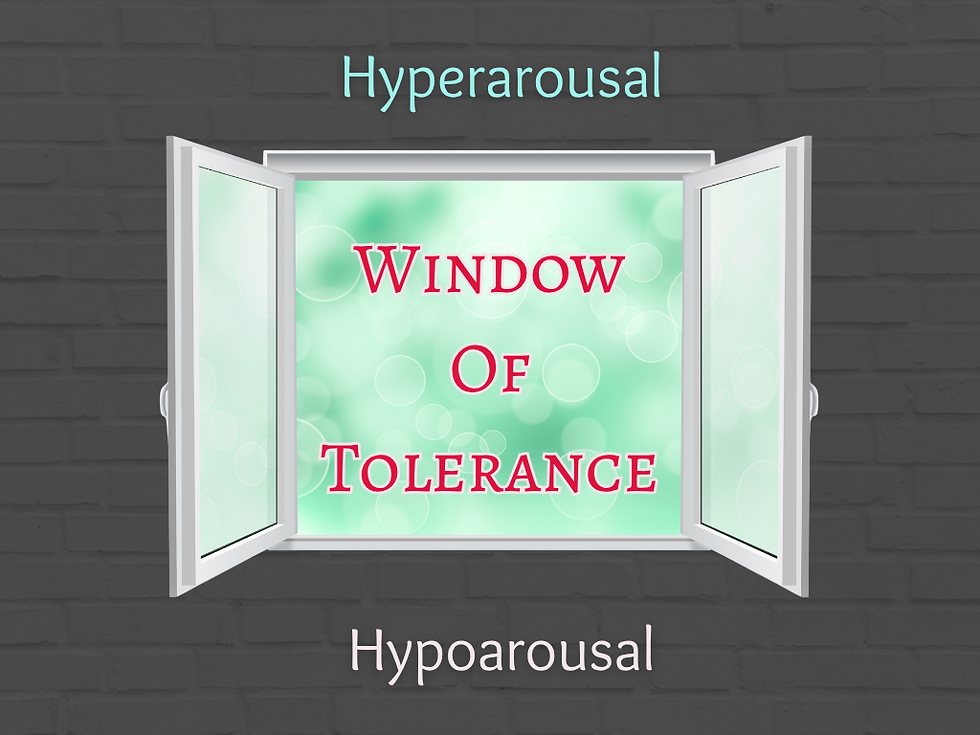
The Window of Tolerance is a concept originally described by Dr. Dan Siegel that helps us understand how we respond to stress. Think of it as the zone where you can function at your best — where you feel present, connected, and in control. Inside your window, you’re able to handle challenges, process your emotions, and respond (instead of react) to what’s happening around you.
But life doesn’t always keep us in that window. Stress, trauma, burnout, or simply too many things happening at once can push us out of our window — and when that happens, our nervous system kicks into protection mode.
We usually shift into one of two states:
Hyperarousal:
This is when your system goes into overdrive. You might feel anxious, irritable, angry, panicked, or like everything is too much. Your thoughts may race, your heart might pound, and your body feels like it’s preparing for danger — even when you’re just stuck in traffic or reading a stressful email. This is the classic "fight or flight" response.
Hypoarousal:
On the other end, there’s shutdown. This is when your system hits the brakes. You might feel numb, disconnected, foggy, or unmotivated. Some people describe it as being frozen or spaced out — like watching life happen from a distance. This is the "freeze" response.
Neither of these states are intentional. They’re survival responses — your body’s way of trying to protect you from what it perceives as threat or overwhelm. And for many of us, especially those who’ve experienced trauma or chronic stress, our window might be narrower, meaning it doesn’t take much to push us into one of these reactive states.

Working with Your Window of Tolerance
When we understand our window of tolerance, it can significantly shift how we treat ourselves during difficult moments. Instead of asking, "What’s wrong with me?" we start to ask, "What does my nervous system need right now to feel safe?"
Here are few ways you can recognize your window of tolerance.
Self-awareness:
Start observing your emotional and physical states, especially when you feel irritable, anxious or lose interest in general. What triggers your stress or anxiety? What situations make you feel calm and grounded? This will give you an idea of how you get affected by different situations,
Identify your cues:
Learn to recognize the early signs that you're moving outside of your window of tolerance. These could be physical sensations (like a racing heart or shallow breathing), emotional reactions (like irritability or withdrawal), or thought patterns (like racing thoughts or negative self-talk).
Mind & Body Work:
Our mind and body are connected. Once you become aware of your window of tolerance, work on recognizing how your body feel in these emotional states. Tightness in the chest, stomach ache, throat closing up, head feeling heavy etc. are some of the more common sensations.
Grounding techniques:
When you notice yourself feeling dysregulated, try grounding techniques like deep breathing, box breaths, progressive muscle relaxation, or sensory regulation like a fidget toy, aroma oils, music etc. These can help in regulating your emotions in the moment.
Seek support:
While these help with managing our window of tolerance, we need to pay attention to how often we feel dysregulated. If you're struggling to understand or manage your window of tolerance, you might need to consider working with a therapist. They can help you develop strategies to expand your window and improve your emotional regulation.

You’re Allowed to Need Safety
If no one ever taught you about this, or if you’ve spent much of your life in a state of high alert or emotional shutdown, know this: there is nothing wrong with you. Your nervous system adapted to keep you safe, even if those responses no longer serve you in the present.
It’s okay to slow down. It’s okay to ask for space. It’s okay to cry, to feel nothing, to not know what you’re feeling — all of it. The goal isn't to never get overwhelmed. It’s to recognize when you're outside your window and to find your way back with care.
So the next time you find yourself spiraling or shutting down, pause and remember: this isn’t weakness. This is your body asking for gentleness.
You’re not too much. You’re just out of your window — and you can come back.


